
How to Calculate the pH of a Buffer Solution After Adding Strong Acid or Base
Master buffer chemistry with this complete walkthrough of calculating pH changes when strong acids or bases are added to buffer solutions. Learn how to use the Henderson-Hasselbalch equation, track stoichiometric changes, and avoid the common mistakes that trip up students on exams.

📹 Video Walkthrough: This Exact Problem
Watch the full solution for calculating buffer pH after adding strong acid or base step-by-step with stoichiometry and Henderson-Hasselbalch calculations.
Table of Contents
The Problem
Calculate the pH after adding strong acid:
A buffer solution is prepared by mixing 0.150 mol of acetic acid (CH₃COOH, Ka = 1.8 × 10⁻⁵) and 0.200 mol of sodium acetate (CH₃COONa) in enough water to make 1.00 L of solution.
Calculate the pH of this buffer solution. Then, calculate the pH after adding 0.050 mol of HCl to this buffer solution.
Assume the volume change is negligible and that HCl completely dissociates.
This is one of those buffer problems that shows up on every chemistry exam. You've got a weak acid and its conjugate base, you add some strong acid, and now you need to figure out what the pH does. It looks straightforward, but there are a lot of places to mess up.
The trick here is understanding that the strong acid reacts with the conjugate base, not the weak acid directly. You need to track the stoichiometry carefully, then use Henderson-Hasselbalch. If you're stuck on a similar problem, you can always generate a custom video solution on Torial.
Understanding Buffer Solutions
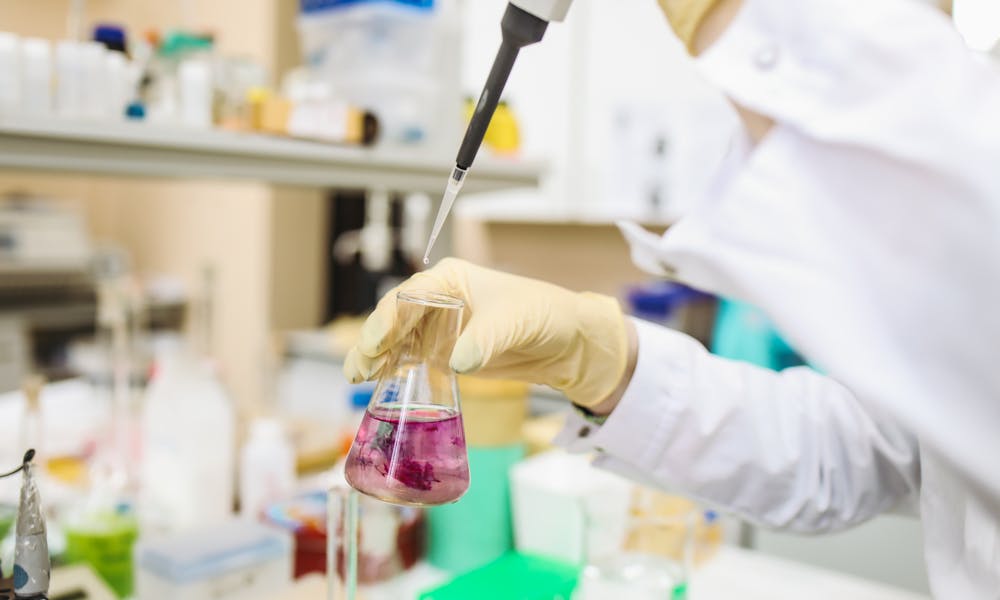
A buffer solution resists changes in pH when small amounts of acid or base are added. It consists of a weak acid and its conjugate base (or a weak base and its conjugate acid) in roughly equal concentrations.
CH₃COOH ⇌ H⁺ + CH₃COO⁻
Weak acid (HA) and its conjugate base (A⁻) form a buffer pair
Important things to remember:
Key points about buffers:
- Buffers resist pH changes because they can consume added H⁺ or OH⁻ ions
- The weak acid consumes OH⁻ when base is added: HA + OH⁻ → A⁻ + H₂O
- The conjugate base consumes H⁺ when acid is added: A⁻ + H⁺ → HA
- Buffer capacity is highest when [HA] ≈ [A⁻] (pH ≈ pKa)
- Buffers work best when pH is within ±1 unit of pKa
For our problem, acetic acid (CH₃COOH) is the weak acid and acetate ion (CH₃COO⁻) is the conjugate base. When we add HCl, the H⁺ from HCl reacts with CH₃COO⁻ to form more CH₃COOH. If you need more help visualizing buffers, check out other chemistry videos in our library.
The Henderson-Hasselbalch Equation
The Henderson-Hasselbalch equation is your go-to tool for buffer pH calculations. It's derived from the acid dissociation constant Ka.
pH = pKa + log([A⁻] / [HA])
Where [A⁻] is the conjugate base concentration and [HA] is the weak acid concentration
Important notes about Henderson-Hasselbalch:
- Only works for buffers where [HA] and [A⁻] are both significant
- Use equilibrium concentrations, not initial concentrations after adding acid/base
- When [A⁻] = [HA], pH = pKa (the log term is zero)
- The ratio matters, not the absolute concentrations (for dilute solutions)
- Assumes [H⁺] from water is negligible, which is usually true for buffers
💡 Key Insight: For acetic acid, pKa = -log(1.8 × 10⁻⁵) = 4.74. This means the buffer works best around pH 4.74, and when [CH₃COO⁻] = [CH₃COOH], the pH will be exactly 4.74.
After adding strong acid, the ratio [A⁻]/[HA] changes, which changes the pH according to the Henderson-Hasselbalch equation.
This equation is powerful because it lets you calculate pH without solving quadratic equations, as long as you're working with a buffer. The trick is making sure you use the right concentrations after the acid/base addition.
Calculating Initial Buffer pH
First, let's find the pH of the buffer before adding any HCl. This gives us our baseline.
Step 1: Identify the components
We have:
[CH₃COOH] = 0.150 M
[CH₃COO⁻] = 0.200 M (from CH₃COONa, which completely dissociates)
Ka = 1.8 × 10⁻⁵, so pKa = 4.74
Step 2: Apply Henderson-Hasselbalch
Plug into the equation:
pH = pKa + log([A⁻] / [HA])
pH = 4.74 + log(0.200 / 0.150)
pH = 4.74 + log(1.333)
pH = 4.74 + 0.125
pH = 4.87
💡 Check your work: Since [CH₃COO⁻] > [CH₃COOH], we expect pH > pKa. Our answer of 4.87 is greater than 4.74, which makes sense. The buffer is slightly basic relative to pKa because there's more conjugate base than acid.
This is the initial pH. Now we need to see what happens when we add 0.050 mol of HCl. The key is understanding that HCl will react with CH₃COO⁻, not with CH₃COOH directly.
What Happens When You Add Strong Acid

When you add a strong acid like HCl to a buffer, the H⁺ ions don't just float around. They react with the conjugate base in a complete reaction.
The reaction that occurs:
H⁺ + CH₃COO⁻ → CH₃COOH
This reaction goes essentially to completion because CH₃COOH is a weak acid
The strong acid (H⁺ from HCl) reacts with the conjugate base (CH₃COO⁻) to form the weak acid (CH₃COOH). This is a complete reaction because the weak acid doesn't dissociate much.
⚠️ Critical point: The H⁺ does NOT react with CH₃COOH. It reacts with CH₃COO⁻. This is the most common mistake students make. They think the acid reacts with the acid, but it actually reacts with the base.
Think of it this way: H⁺ wants to find something basic to react with. CH₃COO⁻ is basic (it's the conjugate base), so that's what it reacts with.
This reaction consumes CH₃COO⁻ and produces CH₃COOH. So [CH₃COO⁻] decreases and [CH₃COOH] increases. We need to track these changes stoichiometrically.
Tracking Stoichiometric Changes
Now we need to figure out how much CH₃COO⁻ gets consumed and how much CH₃COOH gets produced. This is a stoichiometry problem.
Step 1: Determine the limiting reactant
We're adding 0.050 mol of H⁺ (from 0.050 mol HCl). We have 0.200 mol of CH₃COO⁻ initially.
H⁺ added: 0.050 mol
CH₃COO⁻ available: 0.200 mol
Since we have more CH₃COO⁻ than H⁺, H⁺ is the limiting reactant. All 0.050 mol of H⁺ will react.
Step 2: Calculate the changes
The reaction is: H⁺ + CH₃COO⁻ → CH₃COOH (1:1:1 stoichiometry)
CH₃COO⁻ consumed = 0.050 mol
CH₃COOH produced = 0.050 mol
Step 3: Find new concentrations
After the reaction, assuming volume is still 1.00 L:
[CH₃COO⁻]new = 0.200 - 0.050 = 0.150 M
[CH₃COOH]new = 0.150 + 0.050 = 0.200 M
Notice that the concentrations have swapped! We now have equal amounts of acid and conjugate base.
💡 Key Insight: After adding the acid, [CH₃COO⁻] decreased from 0.200 M to 0.150 M, and [CH₃COOH] increased from 0.150 M to 0.200 M. The ratio flipped, which will change the pH.
Since we now have [CH₃COOH] > [CH₃COO⁻], we expect pH < pKa (the buffer is now more acidic than pKa).
This is where a lot of students get tripped up. They forget to track the stoichiometry and just try to use the initial concentrations. But you MUST account for the reaction that occurs. The concentrations after adding acid are different from the initial concentrations.
Calculating the New pH

Now we use the Henderson-Hasselbalch equation with the NEW concentrations after the acid addition.
Applying Henderson-Hasselbalch with new concentrations:
pH = pKa + log([A⁻] / [HA])
pH = 4.74 + log(0.150 / 0.200)
pH = 4.74 + log(0.750)
pH = 4.74 + (-0.125)
pH = 4.62
Final Answers:
Initial pH = 4.87
pH after adding HCl = 4.62
The pH decreased by 0.25 units, which is a relatively small change considering we added a strong acid. This demonstrates the buffer's ability to resist pH changes.
What this tells us:
- The buffer successfully resisted a large pH change (only 0.25 units for 0.050 mol of strong acid)
- Without the buffer, adding 0.050 mol HCl to 1 L of water would give pH = -log(0.050) = 1.30
- The buffer reduced the pH change by a factor of about 14 (from ~3.5 unit change to 0.25 unit change)
- After the addition, [CH₃COOH] = [CH₃COO⁻], so we're at the optimal buffer point (pH = pKa)
Notice how the pH changed from 4.87 to 4.62. That's only a 0.25 unit change, even though we added a significant amount of strong acid. If we had added the same amount of HCl to pure water, the pH would have dropped to about 1.30. The buffer is doing its job.
Understanding Buffer Capacity
Buffer capacity is the amount of acid or base a buffer can neutralize before the pH changes significantly. It depends on both the concentration and the ratio of buffer components.
Factors affecting buffer capacity:
- Total buffer concentration: Higher [HA] + [A⁻] means more capacity. A 1.0 M buffer can neutralize more acid than a 0.1 M buffer.
- Ratio of components: Maximum capacity when [HA] = [A⁻] (pH = pKa). The capacity drops as the ratio deviates from 1:1.
- pH range: Buffers work best when pH is within ±1 unit of pKa. Outside this range, capacity drops rapidly.
💡 In our problem: We started with [CH₃COOH] = 0.150 M and [CH₃COO⁻] = 0.200 M. After adding 0.050 mol HCl, we ended up with equal concentrations (0.200 M each). This means we're now at the optimal buffer point, and the buffer would be even more effective at resisting further pH changes.
If we had added more HCl (say, 0.150 mol), we would have consumed all the CH₃COO⁻, and the buffer would be "broken." At that point, adding more acid would cause large pH changes. Understanding buffer capacity helps you predict when a buffer will stop working effectively.
Common Mistakes to Avoid
Here are the mistakes that cost students the most points. Learn them now so you don't make them on test day. If you want personalized help avoiding these errors, create a custom study video for your specific problem.
❌ Mistake #1: Using Initial Concentrations After Adding Acid
Plugging the original [CH₃COOH] and [CH₃COO⁻] into Henderson-Hasselbalch after adding acid, without accounting for the stoichiometric reaction.
Fix: Always calculate the NEW concentrations after the acid/base reacts. The strong acid reacts with the conjugate base, changing both concentrations.
❌ Mistake #2: Thinking the Acid Reacts with the Weak Acid
Assuming H⁺ from HCl reacts with CH₃COOH. This is wrong - acids don't react with acids.
Fix: Strong acid (H⁺) reacts with the conjugate BASE (CH₃COO⁻), not with the weak acid. The reaction is: H⁺ + CH₃COO⁻ → CH₃COOH.
❌ Mistake #3: Forgetting to Account for Volume Changes
When adding a solution (not pure acid/base), forgetting that the total volume changes, which dilutes all concentrations.
Fix: If you add 50 mL of 1.0 M HCl to 1.00 L of buffer, the new volume is 1.05 L. Recalculate all concentrations using the new volume. However, if volume change is negligible (as stated in the problem), you can ignore it.
❌ Mistake #4: Mixing Up the Ratio in Henderson-Hasselbalch
Writing pH = pKa + log([HA] / [A⁻]) instead of pH = pKa + log([A⁻] / [HA]). The conjugate base goes in the numerator.
Fix: It's always [base] / [acid] in the log term. For a weak acid buffer, that's [A⁻] / [HA]. Remember: "base over acid."
❌ Mistake #5: Not Checking if Buffer Capacity is Exceeded
Adding so much acid that all the conjugate base is consumed, then still trying to use Henderson-Hasselbalch.
Fix: Check if the amount of acid/base added exceeds the buffer capacity. If acid added > [A⁻] initially, the buffer is broken and you need a different approach (usually treating it as a weak acid solution).
❌ Mistake #6: Using Moles Instead of Concentrations
Plugging moles directly into Henderson-Hasselbalch instead of converting to molarity first.
Fix: Henderson-Hasselbalch uses concentrations (M), not moles. If you're given moles, divide by volume to get molarity. However, if volume is constant, you can use mole ratios (they're proportional).
❌ Mistake #7: Sign Errors in the Log Calculation
Getting the sign wrong when calculating log([A⁻] / [HA]), especially when the ratio is less than 1.
Fix: When [A⁻] < [HA], the ratio is < 1, so log(ratio) is negative. That's correct - it means pH < pKa. Double-check your calculator work.
Practice Problems with Video Solutions
Best way to get good at this? Practice. Try these similar problems and check your work with video solutions. You can also generate instant video explanations for any buffer problem you're working on.
Practice Problem 1: Adding Strong Base
A buffer contains 0.100 M NH₄Cl and 0.200 M NH₃ (Kb = 1.8 × 10⁻⁵). Calculate the pH after adding 0.030 mol of NaOH to 1.00 L of this buffer.
Hint: This time you're adding base, so OH⁻ reacts with NH₄⁺ (the weak acid in this buffer). Your answer should be around 9.56.
Get instant video solution on Torial →Practice Problem 2: Different Buffer System
A buffer is made from 0.250 M H₂PO₄⁻ and 0.150 M HPO₄²⁻ (Ka₂ for H₃PO₄ = 6.2 × 10⁻⁸). Calculate the pH after adding 0.040 mol of HCl to 1.00 L of buffer.
Hint: This is a phosphate buffer. The H⁺ reacts with HPO₄²⁻. pH should be around 6.82.
Get instant video solution on Torial →Practice Problem 3: Buffer Capacity Limit
A buffer contains 0.080 M CH₃COOH and 0.120 M CH₃COO⁻. How much HCl (in moles) can be added to 1.00 L before the buffer capacity is exceeded? What is the pH just before the buffer breaks?
Hint: Buffer breaks when all CH₃COO⁻ is consumed. Maximum acid = 0.120 mol. pH just before breaking ≈ 4.38.
Get instant video solution on Torial →Practice Problem 4: Volume Change
A buffer contains 0.200 M CH₃COOH and 0.200 M CH₃COO⁻ in 500 mL. You add 100 mL of 0.500 M HCl. Calculate the new pH, accounting for the volume change.
Hint: New volume = 600 mL. Recalculate all concentrations. Don't forget the dilution! pH ≈ 4.56.
Get instant video solution on Torial →When to Use Henderson-Hasselbalch vs. Other Methods
Should you always use Henderson-Hasselbalch, or do you sometimes need other approaches?
✓ Use Henderson-Hasselbalch When:
- You have a buffer solution ([HA] and [A⁻] are both significant)
- You're calculating pH after adding acid/base to a buffer
- The concentrations are reasonable (not extremely dilute)
- You want a quick calculation
- pH is within ±2 units of pKa
✓ Use Other Methods When:
- Buffer capacity is exceeded (all conjugate base consumed)
- You have a weak acid/base solution (not a buffer)
- Concentrations are extremely low (need exact calculations)
- You need to account for water's contribution to [H⁺]
- The problem explicitly asks for Ka/Kb calculations
For this problem? Henderson-Hasselbalch is perfect. We have a proper buffer with both components present, and we're calculating pH after adding acid. The equation makes this calculation straightforward. When you're juggling multiple concepts, it helps to have a step-by-step video walkthrough that shows exactly which method to use when.
Other Videos
Solving 3x3 Eigenvalue and Eigenvector Problem
Explaining AI Cooking Techniques with Physics Rules
Calculating New Allele Frequencies After Selection
How AI Boosts Learning with Spaced Repetition
Stuck on a Different Problem?
Get instant, personalized video explanations for your homework
Create Your First VideoRelated Articles

How to Calculate the Equilibrium Constant Kc from Initial Concentrations and Equilibrium Data
Complete step-by-step guide to calculating Kc from experimental data. Learn how to set up ICE tables and solve quadratic equations.

How to Calculate pH from the Molarity of a Strong Acid
Step-by-step guide to calculating pH from concentration in acid-base chemistry. Learn the pH formula and avoid common mistakes.